So a couple of days ago the FCC updated a list of banned telecomunications equipment to include, and I’m quoting here;
Routers produced in a foreign country, except routers which have been granted a Conditional Approval by DoW or DHS.
If you want to read it’s all linked on the FCC site linked here.
Now, from what I’m aware there are no domestic manufacturers of routers in the USA. So what they have done is ban the import and sale of any new equipment that does not already have a FCC approval tagged to the device.
If there was a legitimate concern about the security of routers that are deployed in the world why are only new devices being targeted? I would assume that the decision to ban these things is based on some legitimate history of security issues or a history of operating in bad faith on the part of these manufacturers. So if that is the situation why are the existing devices not getting flagged as a problem? Why are we not being told that it’s time to replace those devices?
So if there isn’t a history of bad behavior what is this about? The argument as I understand it is that there are concerns about the security of the devices and their potential to be used as an attack vector rather than any indication that they have been used as such.
Is that legit?
Arguably yes, but without a history of bad behavior this is either the US Government pressuring the hardware vendors to move manufacturing back to the US or it’s a breakdown in the chain of trust that has allowed us to take advantage of offshore manufacturing for as long as we have.
If you look at it every device that you use establishes a chain of trust, regardless of if you realize it or not. Let’s look at your phone, say a iPhone of some generation.
First of all you are trusting Apple, since they built the device and the operating system that it’s running. Implicit in that is that you are also trusting everybody that Apple has trusted as part of their development and supply chain on both the hardware and software side of things. This includes the folks that manufacture the screen, storage, and the developers that write the software that makes up iOS – including any libraries or tools that they use to build the operating system.
You would think that this is fairly simple but the supply chain for software and hardware gets really complicated, really quickly. If you look at the news there have been all sorts of supply chain attacks showing up in the news recently like the one below;
The general idea is to look at software libraries and service providers that your providers make use of and attack those instead of coming after you directly. The impacted software library that I linked above is downloaded somewhere around 3.4 million times per day, and this attack was live for about three hours. Assuming a even distribution of downloads that would mean that the people that got away with this hit 500k downloads while this was live, and who knows where they were able to get from there.
So obviously we have to draw a line and work on the assumption that Apple is doing what’s right our example and that they have done their due diligence on things further down the chain.
So if we take this new ban at face value the US Government has some trust issues with the router manufacturers and is taking steps to try to address those by forcing manufacturing of the devices into the hands of domestic companies that they can regulate and mandate some level of security. However the cynic in me is wondering what hardware vendors – if any – are already going through the process of greasing palms to get exemptions for their hardware in place under this program.
And to be clear it’s going to have to be some level of exemptions going through here – it’s going to take a long time for someone to gear up to build out routers domestically in the US for consumer use considering the number of these things that are sitting in peoples homes, offices, and in datacenters.
So. Apple releases the Macbook NEO less than two weeks ago and suddenly I have a email in from Microsoft through the Windows Insider program that’s talking about the company commitment to Windows quailty.
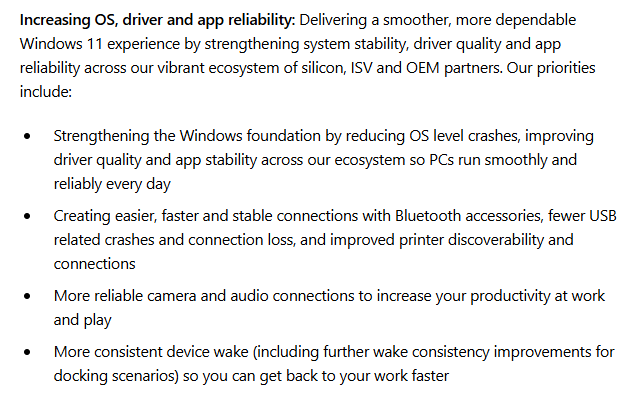
There has been a lot of chatter about the quality of Windows taking a shit over the last few years. So let’s see what they are saying in the message that was just sent out.
Ok.
So that’s not a huge thing for me but I know that a lot of people were pissed off when you pulled that functionality in Windows 11 with no really good explanation why that needed to happen. This isn’t really a huge issue for me, but let’s see what else is in here.
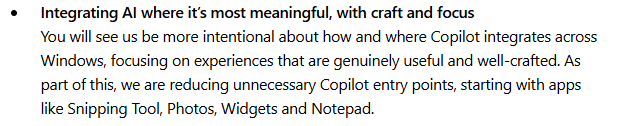
Ohh… And. Here. We. Go.
This is one of the key reasons that I loaded up a copy of Windows 11 LTSC on my computer the last time that I had to do a reload of the OS on my desktop system. To be clear, what I need the operating system on my computer to do is provide me with a entry point to run applications and manage files. I absolutely do not need the operating system for my computer to include out of the box a pile of LLM based bullshit that just consumes system resources.
I get that Microsoft wants to add AI features into the system, and I can understand that people might want to have them but let’s do this – make them a optional download that you don’t have to install instead of being baked in and non-removable by default.
And while we are at it how about we take Windows Recall and stop building spyware and tracking tools into the freaking operating system. The last thing that I want is the operating system tracking everything that I’m doing and providing a catalog for people to dig into my activity on the device upon request.
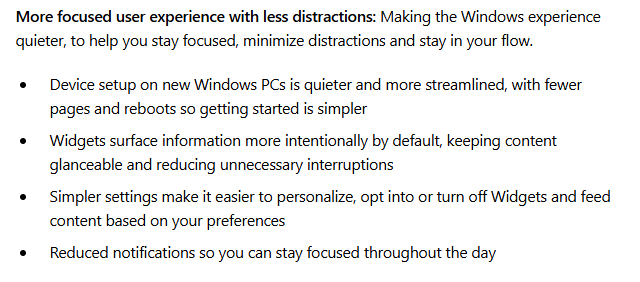
Let’s see what Microsoft’s definition of “Craft” and “Focus” turn out to be.
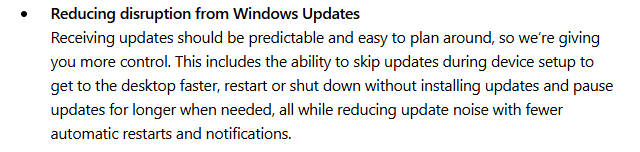
Ok, I’m ok with you streamlining this, and skipping updates during setup might be helpful in some cases, but what about just making it so that the Windows updates don’t completely screw over the operating system when you load them?
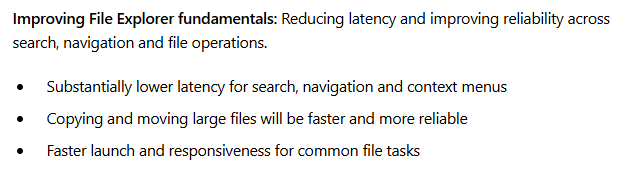
Given that you just posted news a few months ago that you would be pre-loading file explorer in the background to try to improve the performance of the thing I’m sure hoping that you are going to do something other than trying to play shell games with when things are happening.
From what I’ve read online Windows Explorer switched to using different programming models between Windows 11 and Windows 10 and that’s where a huge chunk of the slowdown came from, and if that’s the case I would really like to know why they bothered with that change. File explorer just needs to let me get at my files. I don’t need any entry points for AI crap, I don’t need it to be pre-rendering crap or changing how folders are displayed.
Frankly, all those widgets and feeds have been shut off in my install of Windows. So as long as I can continue that process I don’t really give a crap about this one.
Alright, so more lip service on something that we can’t really quantify.
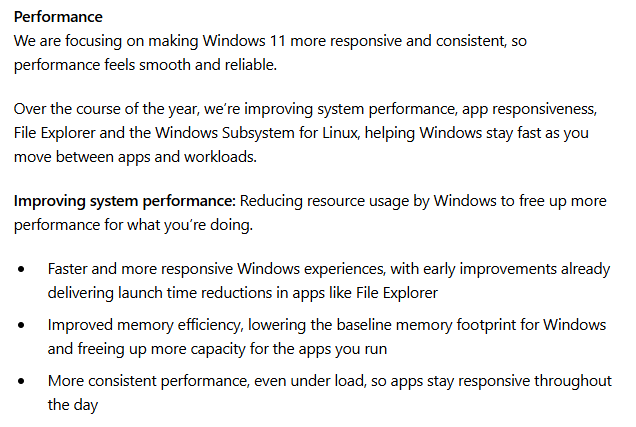
And now we get into some of the actual things they will be doing;
Ok so we are going to de-bloat the operating system to try to speed things up, I’m ok with that, but you really don’t have a choice here. Memory pricing has gone from around 100$ for a 32gb kit of DDR4 to like 350$ for the same kit in the space of less than a year. DDR5 is just as bad, if not worse, and the cost of storage is doing the same. 1tb NVME SSD’s are about double what I was paying for them last year, and even magnetic hard disk drives are climbing in price – when you can find stock on them.
A lot of people, myself included, are looking at the price of memory, disks, and even gpu’s and are going to be deciding to postpone hardware upgrades. My desktop machine is a little long in the tooth right now, but it’s still running everything that I want it to as well as I need it to and unless that really changes I don’t think that I’ll be building out a new system any time soon. Even my laptop is a little older now, but a M3 Pro MacBook is still more performant than I need.
Even if I was having problems with performance I would probably be looking a trying a copy of Linux on my system rather than going and just grabbing another piece of hardware. Given all the BS stuff that’s crept into the OS over the years I have the feeling that a linux install might perform better than what I’m seeing on the Windows side of things.
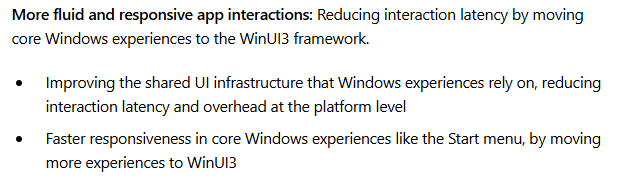
Frankly I don’t care what you call the underlaying frameworks. Just make the dammed thing work properly and make the thing responsive enough that I’m not sitting staring at things waiting for stuff to load out.
Frankly rolling back to Windows 10 would probably fix most of the issues that I have. But sure, let’s see what you can do to make the file explorer more livable.
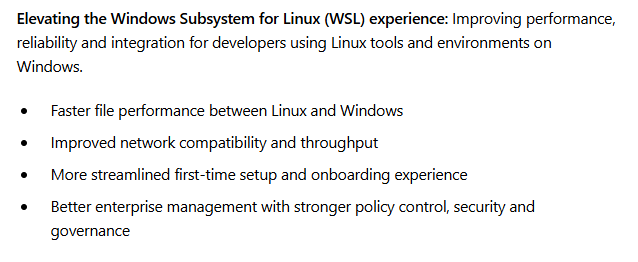
Frankly if I want Linux, I’ll logon to the system(s) that I have running that operating system. I have used WSL in the past but honestly I have always found it to be kind of an odd duck. Any time that I found that I needed to do something that I could do quickly in a Linux terminal on a Windows machine it’s generally taken less time to just re-do whatever I was doing using PowerShell or a plain batch file than to turn on WSL.
I’m sure that there are folks out there that do make use of this thing but I’m not really one of them so big meh from me on this one.
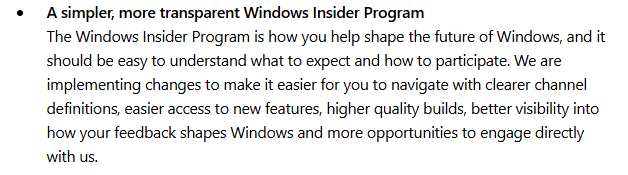
Ok this one is going to be fun, let’s see what you have in mind.
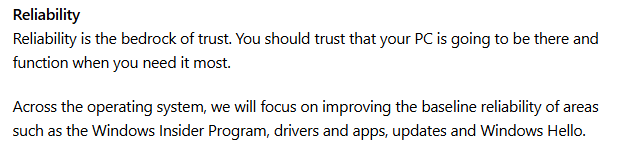
Don’t care. You barely listen to what people are saying we want so this doesn’t really matter to me. Start doing things that prove you give a crap about what’s going on and let’s see where this goes.
Oh please, let’s get this stuff done. I have had nothing but issues with all my windows laptops for years when I’m pulling them on and off docking stations. These power issues are things that I have NEVER had with any of the macOS devices that I’ve used.
And yes please start holding your hardware partners to a standard where their drivers work better. There’s been piles of examples where NVidia’s drivers have shit the bed in the last few years, and I remember having all sorts of issues with the AMD GPU drivers when I was running the RX580 – I don’t think that I ever let that computer sleep while the GPU was installed. If I did the dammed thing would never come out of a sleep state.
Granted you have a harder fight here than Apple does. Apple controls all the hardware that’s going into their devices out of the box, where you don’t have that level of control outside of the Surface devices. I suppose that you are getting closer with the ARM based laptops, but most of those are still being built by other OEM’s that you don’t have the ability to completely dictate terms to, but come on it’s been years of this and frankly it’s one of the major things that drove me to picking up a MacBook for my personal laptop last time around.
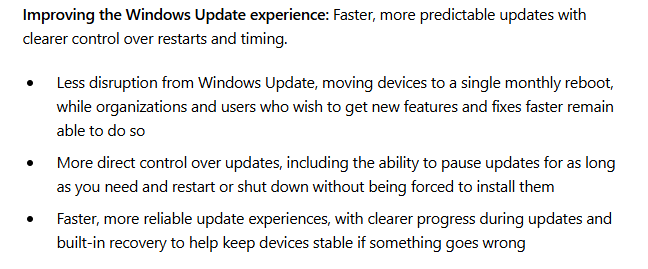
Ok, so Windows Updates aren’t a thing that bothers me that much, but most of the time don’t you only push updates out at the start of each month?
I don’t have much of a problem with the Windows Updates needing to be installed and I don’t find the general process to be that invasive for the most part. However I do remember the days of Windows XP where people would go years or longer between running updates and the resulting mess that type of approach would cause.
Don’t really care. Not a huge fan of biometrics being stored on my device given what you have been doing with Windows Recall. That’s not information that I’m sure I want to trust you with right yet.
Again, don’t much care. Just pick something and stop screwing around with the dammed layout. All that I need the start menu to do is point me to where to load a application and access settings.
Ok that might be interesting. Most of the time I wind up leaving the computer with the notifications just turned off because they are at a point where they are really quite distracting.
Search has been crap for years, anything that you do would probably be helpful here but personally I’m generally aware of where things live on my computer well enough that I don’t frequently have a lot of use for searching for random crap on the machine.
If you want to have a look at the full message that they put up you can see the thing here.
It’s a lot of the right type of noise but you know that this is being done now because Apple has suddenly dropped the entry point for someone to jump into their ecosystem considerably. And say what you will about Apple their user ecosystem and user experience across their devices is solid. The limiting factor to getting into there has always been the “Mac Tax”. You can argue the value of the macOS hardware compared to Windows devices at the same price point but the simple fact is that your point of entry into a macOS device has always been higher than that of a Windows one. But now I’m not aware of many, if any, Windows devices at the price point of the MacBook Neo that have the same build quality and user experience that you would get from the Neo.
Actions speak louder than words, so we will see what comes up over the next couple of feature releases. If it’s all more AI packed slop, well it might be time to start looking at moving over to Linux for my gaming machine.
One of the things that I have spent some time playing with is storage solutions for deployment at home. My primary use for a storage server is to store backups from my other systems, media for streaming in my house, and a general dumping ground for files that need to move around machine to machine.
The obvious solution was to go pickup something from Synology, Qnap, or one of the other vendors who build solutions purpose built for this type of thing and deploy that. However a lot of those solutions were at the time priced more for business use rather than deployment at home. As well I got bit in the past with a Western Digital MyCloud that had somewhat lacklustre firmware updates over time resulting in my decision to go shopping around for something a bit more robust for a solution.
Ruling out a purpose built device means that I’m building my own server and the choice comes down to what software is going to be backing the thing once it’s deployed. The only package that I found at the time that would handle the mix of random drives that I had sitting around at the time was Unraid. Unraid’s method of data protection uses a non-standard type of RAID that uses the largest disk in your array to provide protection in the event of a disk failing in the array. Unraid has a good description of the protection they have in place in their user documentation.
Looking at TrueNAS the ZFS pools that it uses have advantages with from a data resiliency standpoint, from a performance standpoint, as well as the ability to pull off some neat tricks with snapshots. However it doesn’t really handle the mixed pile of disks that I was working with at the time, something that was fairly important since I didn’t want toi go out and buy a pile of new disks when I had plenty sitting around collecting dust.
Another thing that people will probably be quick to point out is that Unraid is not a free solution. When I bought the software it was a single purchase based on the number of drives that you are looking to attach to the server. Pricing is similar now but unless you purchase the “Lifetime” version it doesn’t come with lifetime updates, so that’s something that you should be aware of. From my viewpoint I personally prefer free solutions wherever possible however paying out for Unraid got me up and running quicker than I would have been able to if I was going to try to roll my own solution.
Getting Unraid installed on a USB key is fairly straightforward and once you boot the machine that you are going to use as a storage server from the USB device you just select the drives to add to your array, setup your shares, and you are basically up and running. You can get more stuff running as you start bringing containers into the picture but for basic file services it’s not much more complicated than that. Swapping out drives to increase capacity or when one dies is dead simple, provided that your parity devices are working properly.
I’ve run this Unraid server now for a number of years and it’s done pretty much everything that I have needed for a long while, however there are a couple of things that might be nice to have that TrueNAS does do out of the box. The ability to replicate snapshots between two servers, as well as the ability to upload copies of the data to a cloud storage provider makes backing up things much simpler than what’s in place in my Unraid server right now. And yes, there are a number of plugins and other things that can make this type of function happen on a device running Unraid, but none of them are things that have been baked into Unraid by the developers at this point, so I’m reliant on somebody else maintaining and keeping those plugins updated and functional as Limetech does their thing.
So now to the question of what someone reading this blog should do. That’s kind of going to depend on what you need the storage to do for you and what you happen to have laying around.
If you don’t have a existing system that you can reuse as a server then I would have a look at a pre-built solution like what Ugreen, Synology, or Qnap offer. The pricing on the 2 and 4 bay solutions has dropped over the years to a point where you could potentially get a cheaper system to act as a host but it might not really be worth it given the extra work in stuffing the disks into a used machine that wasn’t meant to take them.
If you have a spare machine sitting around with enough SATA ports and NVME sockets to make a usable server and you are going to be purchasing new drives to work with I would be looking at TrueNAS, if you have a pile of mismatched drives that you want to reuse then I would still go with Unraid as long as the drives that you are working with are large enough to offset the price of the Unraid license that you have to purchase instead of putting that money towards a matching set of drives.
The last several years the news has all been about AI and how it’s going to completely transform the world. And over the last couple of years I have had a really hard to pin down feeling of foreboding about all these advancements that have come out using these new tools.
Recently I came across a book that kind of put some of my feelings into words. And I think that anybody interested in the subject of AI should be looking at this book. It’s definitely not the sunshine and roses that some people paint AI to be so be prepared a bit when you dive in.
The thing that I think is interesting about the state of AI right now isn’t so much what it’s able to do but what some of the people who work with it have done in the last little while. A big one that you might have seen was Mrinank Sharma who was the head of AI Safety at Anthropic. He posted a note on X with the contents of his resignation letter.
In reading through that it kind of sounds like the folks at Anthropic were being presented with a bit of a moral quandary about the use of their AI agents. And I wonder if that might have had something to do with the recent news regarding the concerns about the use of Anthropic’s tech by the US Department of War?
That points out a lot of interesting things. The one that bothers me the most is that a lot of the companies have been rolling back commitments that prevented the use of their technologies in weapons and surveillance applications. Using a AI tool to generate stupid memes of cats is one thing, using an AI tool to automate the surveillance of an entire populace, or using that tool to decide where a bomb should be dropped?
As much as I am not a fan of people getting killed, I’m even less of a fan of people being killed because a machine pointed at them and said “this one”.
I think that the authors of the book I linked above kind of have it right. We are playing with things that we don’t really understand and that we don’t have the tools to handle safely. For the most part people are using it for things that aren’t going to end the world, but how long before somebody hooks one of these things up to something that is life safety critical and causes things to go really off the rails?
So, now that the MacBook Neo is starting to get into peoples hands and they are starting to tear into the thing there are a coupe of interesting things about this device that are starting to make me think that it might be something that I would be interested in putting my hands on.
The biggest surprise to me was the repairability scores it was given by iFixit during their teardown, notably;
The battery is screwed in and can be replaced.
The keyboard is screwed in and can be replaced without replacing the entire top cover.
The ports are all on separate daughterboards that can be replaced if a port goes bad.
Granted the use of a Phone CPU and the limitation on the amount of system memory that the device can address is still a concern but having a device that doesn’t require major rework on the motherboard when a port on the side of the device breaks is definitely a win.
Reparability is one of the reasons that I’ve been a fan of Thinkpads for as long as I have. Parts for those are relatively easy to get hold of and unless you have really mangled the device they are generally worth repair. Apple’s stuff has been a little more difficult because they have generally glued batteries in and in many devices the keyboard can’t be repaired without replacing the entire top shell of the laptop because the keyboard is riveted into the case.
I’m sure that some of this is coming up because of regulations in the EU that are going to require user replaceable batteries in devices by a specific date, just like the move to using USB C charging over all the bespoke connectors was driven by legislation in that market. Hopefully this is a sign of things to come as Apple refreshes their devices in the coming years, since I really don’t want to have to pry old batteries out of a device if the only thing that I gain is a 1mm reduction in the size of the device.
In around 2004 I finally got around to looking into and purchasing a updated camera to replace my film camera. I had been looking into digital cameras for years at that point and while they were neat they where either too expensive or didn’t take good enough photos to make it worth looking at using one full time.
I did have a couple of smaller ones over the years, a Olympus that I don’t recall the model of and a A75 that was good enough, but they were all missing the controls and handling of a “proper” camera.
When looking at options I was initially looking at a Canon option, however since none of my older film lenses would have been able to be used I did start looking into other options and at one point I was handed a Nikon D70 and the feel and ergonomics of that camera basically sold me on that specific piece of hardware.
I initially purchased the device as a part of a kit with a 18-70mm lens and eventually added a 55-200 AF-S VR, a 50mm, and a 100-300mm Sigma Lens into the bag. A Nikon SB600 flash head was added at some point along with a pile of other random accessories that were bought to fill out the bag.
The camera body itself worked great and I shot with it for almost 20 years, the camera handled weddings, kids, vacations, and all sorts of other events over the years without giving me any huge issues or problems on it’s own. Even after almost 20 years of use the only thing that’s really an issue with the body is that the rubberized coating that is on the high touch parts of the body degraded to the point where it was sticky and unpleasant to touch. That was fixed by simply scrubbing it off the plastic with IPA, but aside from that the camera still works to this day.
As far as the lenses, none of what I bought over the course of using the camera was what would be considered a “professional” lens, but that 18-70mm and the 55-200mm gave me great service in all sorts of conditions without any problems. The 50mm lens was, in retrospect, something that I should probably have held off on, but I wanted a prime lens and I had been shooting with a 50mm on my film cameras for years, but I didn’t take into account the crop factor of the camera body when buying the lens. Given that the body has a 1.5x crop factor that makes that 50mm lens a 75mm effective field of view and that wasn’t a lens that I had shot in the past. What I should have bought was a 35mm lens since that would have worked out to be effectively a 52 mm lens with the crop factor.
While the camera did work well for me there were some gripes that I had;
The D70 never did release a battery grip, I’m not sure why but the camera didn’t even have a external trigger for the shutter and from what I can tell they never did put the appropriate connectors in to support a remote shutter on a vertical grip.
There were some 3rd party ones but they mostly just added battery capacity, nothing else since there was no way to trigger a remote shutter from the grip. I did see one that seemed to use a piece of optic cable to redirect a IR signal into the body but that never sat as a great solution.
The camera didn’t work really well with larger compact flash cards, leaving me having to mostly rely on smaller 512mb cards, and even with the smaller pictures from the 6mp sensor I would still burn through all my smaller cards fairly regularly.
In the end the camera still worked 20 years down the road, however a few other things gave out. The autofocus screw on the Sigma 100-300 telephone lens eventually stopped working, making that lens a manual focus only one. The SD cards started showing problems with being read and mounted – and larger ones just didn’t really work reliably. And the batteries were basically burnt out to the point where you can’t really shoot for long with the ones that I have.
All of these things are “fixable”, the replacement batteries aren’t horrendously expensive, provided you don’t get the Nikon branded ones. The CF cards can still be bought in sizes that should work, but either they come from a vendor that I’ve never heard of or cost as much as cards that are significantly larger. The Sigma lens was not something that I used enough to really be terribly upset about loosing autofocus on it, and it was cheap enough that getting it repaired would cost more than I spent on it in the first place.
Eventually I wound up replacing the camera with a newer Nikon late in 2025, and that’s still a work in progress.
The D70 is still around and will remain in the collection along side my film cameras, and it may get trotted out from time to time. I can’t however complain about a piece of technology that I’ve gotten 20 years of use out of though.
It does kind of reinforce the idea of purchasing something, paying once, and crying about it once rather than picking up cheaper solutions over and over again.
So Apple has announced some new laptops and I’ve seen a couple of reviews about the MacBook Neo that’s coming out and I have some thoughts about it.
Some folks seem to be really critical about the device having a CPU that was previously used in the iPhone or about the amount of memory and storage space on the device. Some seem to be thinking that this device is going to be the ChromeBook killer given the relatively low (for Apple) price.
Honestly for me the device isn’t something that is that interesting, not because it’s not a good device. More because it’s simply not targeted at me.
This type of device is the laptop that someone who just wants a “laptop for school” but doesn’t care about the specification will pick up. They will wind up grabbing it from the Apple store withe AppleCare and will probably walk out the door just around 1000$ out of pocket with a device that should last them through the next couple of years of school or basic email and social media.
As far as it killing Chromebooks, I don’t know about that. Chrome OS devices have a whole ecosystem that they live within and the macOS devices are not going to live in that same ecosystem in the same way I can’t see them completely displacing Chrome OS in an organization that has already heavily invested in them. If the organization is one that’s currently sitting on a bunch of late model Intel MacBook Air’s or first generation M1 devices this device gives those customers a price point to move over to newer hardware that’s hopefully going to be faster.
The storage options and memory options do irk me a bit, but again I’m not the target for this thing. What is interesting is that Apple has a pretty good track record of providing reasonably long support windows for their devices. If they are still releasing a device in 2026 with only 8gb of system memory that kind of indicates that they intend to support that as a viable configuration for some time to come. For the rest of us out there that bodes well since they will probably have to avoid adding in bloat and garbage into the OS while these devices are still in production.
The lack of a backlight on the keyboard, the difference in the speaker setup, the difference in the camera setup, are all things that a lot of people who just need a laptop to work on probably won’t care about. And frankly those limitations make sense since it’s going to prevent Apple from driving the people who would have normally bought a MacBook Air into the MacBook Neo. The people picking this up would be the people who are price sensitive rather than the people that care about the specification of the device.
I honestly can’t recall the last time that Apple had a laptop at this price point. From what I can recall the entry point for any Apple laptop has always been around the 1000$ mark. Seeing them getting into the mix at a 600$ entry point is interesting and I would love to see what happens to the higher end iPads during this time period. I know more than a few people who picked up iPad Pro’s and keyboards for them instead of doing a laptop to save a few dollars.
Unfortunately for Microsoft I think this is going to eat more of their lunch than anybody else. Unless you wanted or had to use a ChromeOS device Windows was the option at this price. Given all the crap they are bundling now with Copilot, and that Recall feature in Windows 11 some folks may just elect to move over now that there is a cheaper option to get into the ecosystem with.
Would I buy one?
Nope.
But I’m not the person this device is aimed at. You could be, and if that’s the case it’s definitely worth a look.
Frankly, I’m nobody in the grand scheme of things and you probably shouldn’t really care what I have to say about anything posted here. This blog is going to be a place for me to toss down random comments on things that I’m interested in and anything here is my opinion, nothing more.
Feel free to read through as I’m posting things here and if something that I post makes sense or resonates with you that’s great to hear. Keep in mind however that I’m just another random voice on the internet and anything that I’m posting here should be taken with a grain of salt and you should be doing your own homework to make sure that I’m not completely off my rocker.
That said, I’m interested in Technology, Photography, and I have been trying my hand at learning Brazilian Ju Jitsu for the last several years.
On the technology side I like playing around with different types of technology, but I also don’t get super excited about things unless there’s a actual reason or application for the technology that I can make use of. So while I’m really interested in 3d printing the current excitement over the sate of “AI” stuff does not really catch my eye as much.
That whole AI thing is a discussion for another post since I can rant about that specific piece of tech all day long.
I have spent a lot of time playing around with networking equipment, servers, laptops, desktops, mobile devices, and the management of all those devices. I have opinions on all of them, some more informed than others, and I’m sure that we will get into the topic of managing hardware at some point.
Photography is something that I’ve been doing off and on since I was young. My first Camera was a Canon T60 that I was given as a Christmas present in high school and I’ve been taking shots ever since. Around 2006 I made a switch over to using a Digital SLR and transitioned away from shooting film. As much as I liked shooting film I don’t really miss the work in the darkroom or the cost of getting film processed if I didn’t feel like doing it myself.
Most of what I shoot winds up being scenery, landscapes, things like that. I’m not huge on taking photos of people since people can in many cases object to having photos taken and I try to respect that.
On the sporting side I do find myself taking part in Brazilian Ju Jitsu – it wasn’t something that I sought out but I wound up taking some classes and it’s stuck with me for a bit. A bit being long enough for me to get my belt awarded last year and for me to start the process of training for the IBJJF worlds with a eye to going and actually trying my hand in competition this year.
So I’m no expert, and I wouldn’t call myself a competitor but I’m probably a bit more than what you would consider a casual player in the sport if that makes any sense.
As far as politics or religion, I’m going to try to keep that out of this space. I did used to try to talk through this type of thing with people but the current situation in the world makes that difficult to say the least. A lot of people are just taking the stance that if you don’t have the exact same views they do that you are their enemy. So In general I don’t actively go looking for that type of conversation any more.
Anyhow, that’s a bit about me. Stay tuned for more as I get around to typing up stuff here.
Back in 2015 I originally started this up as a place to rant, toss messages around, and in General just mess about with things. Honestly for the most part it was hard to bother with keeping things updated since none of what was posted was actually anything that I saw value in.
So, second round, let’s give this another try and see if something of value can’t be put on this page.